
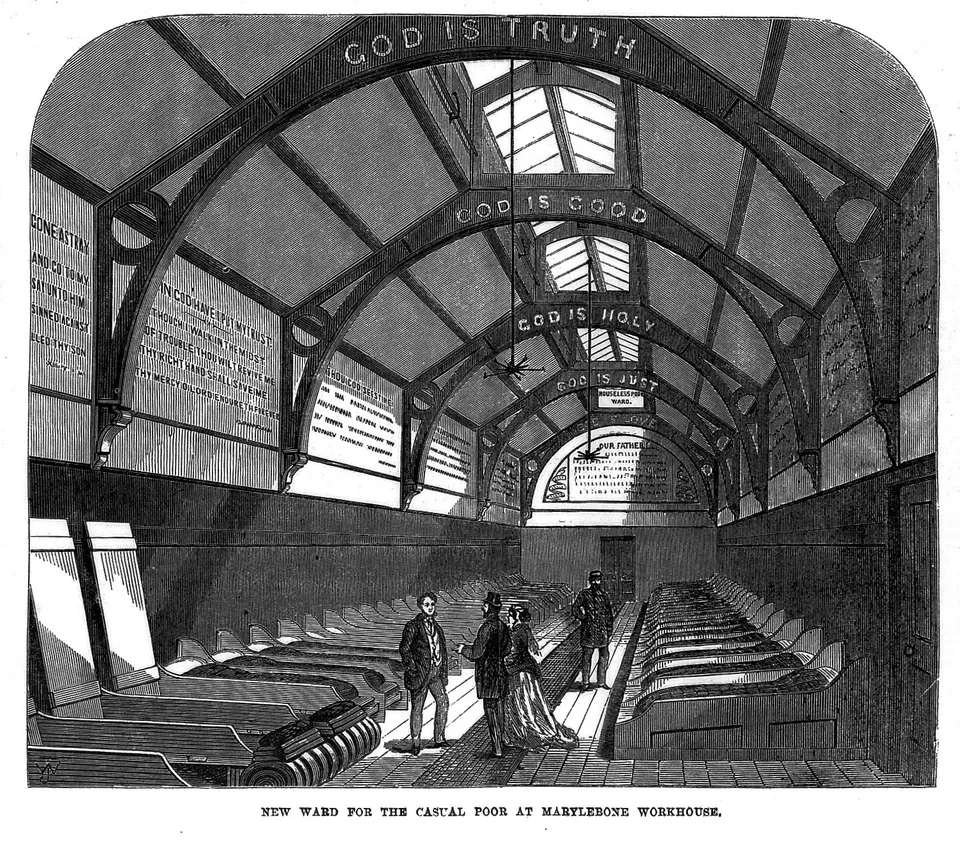
Would you know if your great-great-grandmother died in the workhouse? Many families wouldn’t. The shame attached to the workhouse ran so deep that people carried the secret to their graves, and their children never spoke of it.
I want to say this plainly at the start: finding the workhouse in your tree is not a stain. It is evidence of a family that survived the hardest chapter of industrial Lancashire. By the end of this post I hope you will see these records the way I do, as some of the most detailed and human documents a genealogist ever gets to read.
Why the workhouse hides in plain sight
After the Poor Law Amendment Act of 1834, parishes were grouped into unions, and each union built or ran a workhouse. Lancashire’s mill towns all had one: Preston, Blackburn, Burnley, Bolton, Oldham, Rochdale, Chorley, Haslingden and more. In a county living on cotton wages, one bad winter, one dead husband or one trade slump could put a respectable family inside those walls. During the Cotton Famine of 1861 to 1865, when the American Civil War cut off raw cotton and the mills fell silent, whole towns went onto relief. If your family worked the mills (I wrote about finding your mill ancestors earlier this year), the poor law records are not a long shot. They’re a probability.
Yet the word ‘workhouse’ rarely appears where you would expect it. Which brings me to the single most useful thing I can teach you here.
The disguised address
From the late Victorian period onward, officialdom quietly helped families hide the workhouse. Registrars recorded institutional births and deaths under an ordinary street address rather than the institution’s name. A death certificate might simply say “126 Deepdale Road, Preston”. Nothing on the document tells you that this was Preston workhouse.
So the technique is this: whenever an ancestor was born or died at an address that does not match where the family lived, check that address against the known institutions of the town. Lists of workhouse street addresses are well documented for every Lancashire union. I keep a database of them for exactly this reason, and the moment a certificate address matches one, the story of that document changes completely.
The census plays a similar game. Workhouse inmates were enumerated inside the institution, listed as ‘inmate’ or ‘pauper’, often with initials in place of full names in some years. If an ancestor vanishes from the family household in one census and you can’t find them, search the institutions of the union they lived in before deciding they must have emigrated or died.
The records themselves, and what they hold
Once you know a family passed through the workhouse, the union’s own paperwork opens up, and it is astonishingly rich.
Admission and discharge registers record who came in, when, why, and when they left. A family admitted with the reason ‘husband in gaol’ or ‘mill stopped’ tells you more about their circumstances than a decade of census returns. Creed registers note religion, age, occupation and last address. The minute books of the boards of guardians record individual cases discussed by name: applications for outdoor relief, boots for children, a widow’s coal allowance. Some unions kept registers of children boarded out or sent to industrial schools, which can explain a child who seems to disappear from the family.
Outdoor relief matters just as much as the workhouse itself. Far more Lancashire families received relief in their own homes than ever went to the workhouse, especially during the Cotton Famine, and the relief order books capture them week by week.
Where to find them
The bulk of Lancashire’s poor law material is held at Lancashire Archives in Preston, catalogued by union. Records for the unions that fell into the historic county’s southern towns are split between there and the Greater Manchester and Merseyside record offices, so check which union your town belonged to first rather than which modern county it sits in. Survival varies by union: some kept nearly everything, some lost their admission registers entirely, and almost none of it is online. This is archive-visit territory, which is honest work with a paper trail, and it’s part of what clients pay me to do on their behalf.
One caution on access: records naming individuals are typically closed for 100 years, so material from the 1930s onward may not yet be open.
Reading them without flinching
I’ve traced families who entered Preston workhouse three times in a decade and walked out three times, back to the looms, back to their children. The registers don’t record failure. They record the years a family had nothing except the will to get through, and got through. When I find the workhouse in a client’s tree, I present it exactly as I would a soldier’s service record: as part of the evidence of a life.
Has an ancestor of yours ever simply vanished between two censuses? The poor law records may know where they went. Get in touch for a free consultation, or see what a full search involves on my Services and Prices page.