
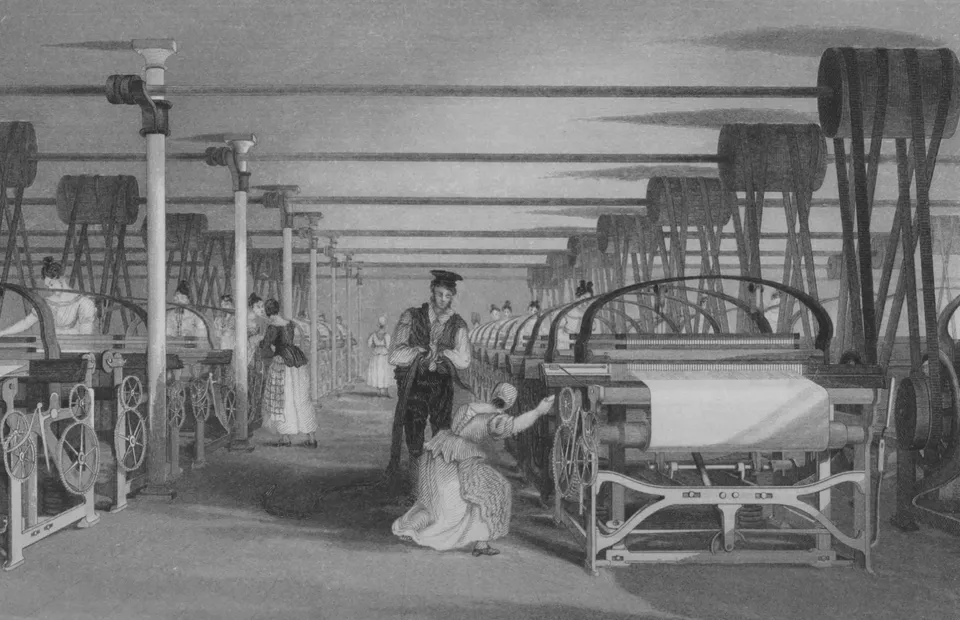
If your family has roots in Lancashire, the odds are high that somewhere in your tree there is a weaver, a spinner or a piecer. Through the nineteenth century, Lancashire was the centre of the world’s cotton industry, and whole towns (Blackburn, Burnley, Bolton, Oldham, Preston, Rochdale and many more) grew up around the mills. For a genealogist, that history is a gift: the cotton industry left deep marks in exactly the records we use to trace families.
The occupations that give the game away
The census is usually where a mill family first shows itself. From 1841 onwards, each census records occupations, and Lancashire returns are full of the industry’s job titles. Some of the most common you will meet are:
Weaver and power loom weaver - the largest group, and in Lancashire very often women. Spinner and self-acting minder - operated the spinning mules. Piecer - often a child or teenager, who repaired broken threads while the machinery ran. Carder, doffer, tenter, winder, reeler, beamer, tackler - (the overlooker who maintained the looms) Cotton operative - a ‘catch-all’ used by the enumerators when they didn’t get a specific occupation.
These titles do more than colour in a life. They can distinguish two people of the same name in the same town, confirm a family link when a father and son share a specific trade, and tell you which part of the mill, and sometimes which social layer, your family occupied. A self-acting minder and a piecer stood at very different points of the mill hierarchy, even when they were father and son working side by side.
Children in the mills
It can be uncomfortable to find, but many Lancashire trees include children working in the mills. Through much of the nineteenth century, children worked as piecers, scavengers and doffers, and after the Factory Acts many became “half-timers”, spending half the day in school and half in the mill. If a census shows your 10 year old ancestor as a “cotton piecer, half time”, that isn’t a transcription error, it’s a precise record of how childhood worked in a mill town, and it often explains the school records (or the gaps in them) that you find alongside.
The Cotton Famine and the uprooting it caused
Between 1861 and 1865, the American Civil War cut off raw cotton supplies and threw Lancashire into the Cotton Famine. Mills closed or went onto short time, and relief committees supported thousands of families. If your family seems to vanish from a mill town in the early 1860s and reappear somewhere unexpected, the Cotton Famine is one of the first explanations worth testing. Some families moved to other textile districts, some to the coalfields, and some emigrated altogether.
Where the records are
Beyond the census, several sources regularly bring mill ancestors back to life. Parish baptism registers frequently record the father’s occupation, letting you follow a man’s progress from piecer to spinner across his children’s baptisms. Trade directories list mills and their owners, useful for understanding who your ancestors likely worked for when the census only says “cotton weaver”. Local newspapers reported mill accidents, strikes, celebrations and prosecutions under the Factory Acts, sometimes naming ordinary workers. And Lancashire Archives in Preston holds a wealth of material for the county, including records from some individual mills and the communities around them.
Not every mill kept surviving staff records, so I will be honest: it is rare to find a wage book with your ancestor’s name in it. But the combination of census, parish and newspaper evidence usually builds a vivid picture of a mill family’s world even when the mill’s own paperwork is gone.
Turning occupations into a story
This is the part of my work I love most. A tree that says “Mary Ann, weaver” is accurate. A family history that explains that Mary Ann was one of thousands of Lancashire women powering the largest cotton industry on earth, working the looms through the Cotton Famine, is a story your family will actually retell. That is the difference a professional search makes.
If your family worked in the mills and you would like their story traced properly and told well, have a look at how my research works or get in touch for a free consultation.