
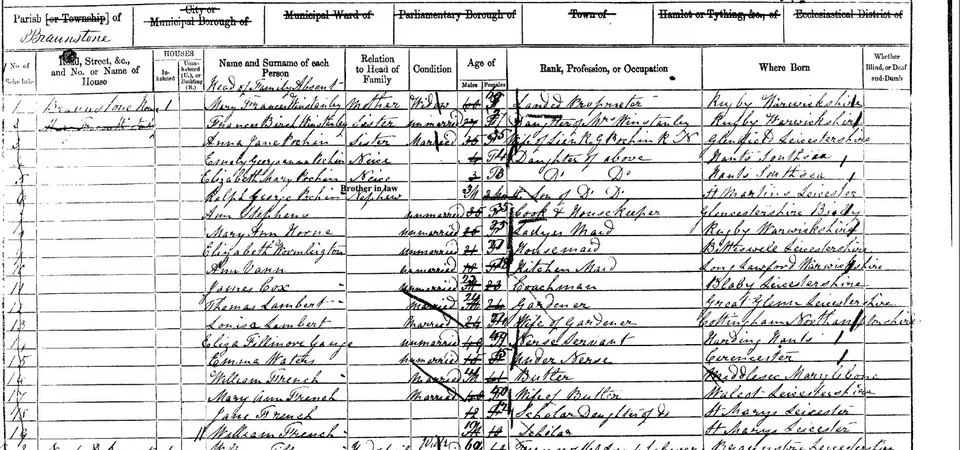
How can the same woman be 24 in 1841, 36 in 1851 and 44 in 1861? She can’t, obviously. Yet I meet her, or someone like her, in almost every tree I research. New researchers often panic at this point and conclude they’ve got the wrong person. Usually they have the right person and the wrong expectations. Census ages were never reliable, and once you know why, the inconsistencies stop being obstacles and start being clues.
The 1841 rounding rule
Start with the census that misleads more people than any other. In 1841, enumerators were instructed to round the ages of anyone over 15 down to the nearest five years. A woman of 24 was recorded as 20. A man of 39 became 35. Children’s ages were given exactly, but adults were deliberately blurred.
Not every enumerator followed the instruction, which makes it worse: you cannot even rely on the rounding being there. The rule to carry with you is that an adult’s 1841 age is a floor, not a fact. Someone listed as 20 was anywhere from 20 to 24. If your ancestor ‘ages’ 14 years between 1841 and 1851, they haven’t fallen through a wormhole, the 1841 figure was just rounded.
Honest ignorance
The second reason is more human. A large share of our ancestors genuinely didn’t know how old they were. Civil registration of births only began in England and Wales in 1837, and plenty of births went unregistered for decades after. Before that, the only record of your arrival was a baptism, which might have happened weeks, months or occasionally years after you were born. Birthdays were not the annual events they are now. Ask a Preston weaver in 1861 how old she was and you would get her best guess, and her best guess drifted over the years.
Add to this that the person answering the enumerator’s questions was often not the person being described. A head of household guessed his lodger’s age. A neighbour answered for the family next door. A wife shaved a couple of years off a husband who was not home to object.
Deliberate lies
Then there are the fibs, and they follow patterns worth knowing.
A wife noticeably older than her husband often made herself younger census by census until the gap looked respectable. Men lied about their age to enlist in the army, in both directions. Workers nearing the age where a mill or mine would let them go sometimes stayed conveniently 58 for a decade. And a couple who married in a hurry might adjust ages, or a first child’s age, to tidy the arithmetic. Marriage certificates join in: the phrase ‘of full age’ just means ‘21 or over, or so they claimed’, and it hides a multitude of birthdays.
None of this is a research disaster. A lie has a direction and a motive, and both are information. When a woman’s stated age drifts downward across four censuses, I don’t have a puzzle, I have a lady addressing her marriage to a younger man. Her true age is almost certainly at the older end of the range.
The method: build an age grid
Here is how I actually pin a birth year down, and you can do it at your own kitchen table.
Take one ancestor and write down every age or birth year implied by every document you have: each census, the marriage certificate, the death certificate, the burial register, any military papers. Convert each one into an implied birth-year range (remembering the census was taken on a specific spring night, so someone aged 30 in April 1861 was born between April 1830 and April 1831). Then lay the ranges side by side and look for the overlap.
Two rules govern the grid. First, not all sources are equal. A baptism register entry, made within weeks of the event by a clergyman with no reason to lie, outranks every census guess. A death certificate age, supplied by a grieving relative, is often the least reliable number on the sheet. Second, when one source disagrees with all the others, ask who supplied the information and what they had to gain. The answer usually resolves the conflict.
When the overlap points to a year or two, the General Register Office birth indexes (which since 1911 show the mother’s maiden name, and now do so for earlier years in the online index) usually finish the job.
When the ages still will not behave
Sometimes the grid refuses to converge, and that itself is a finding: you may be looking at two different people of the same name, merged into one by an over-eager tree. Untangling same-name individuals in one Lancashire town is bread-and-butter work for me, and it is one of the most common repairs I make to trees that clients bring me. It’s exactly what my tailor-made research is for.
Which ancestor of yours never gives the same age twice? Tell me about them in a free consultation and I will tell you honestly whether the tangle can be solved.