
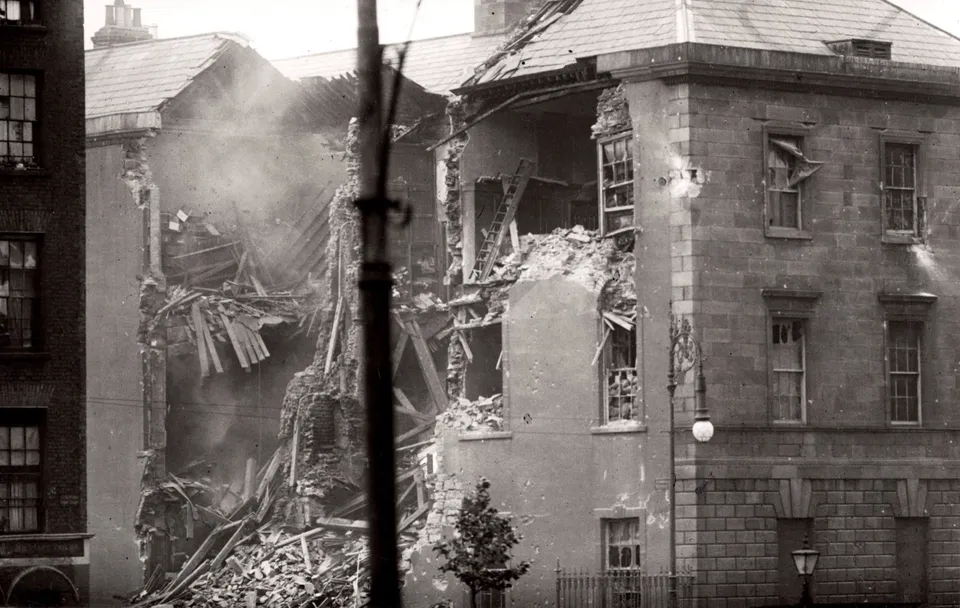
Whenever a client tells me they have Irish ancestry, I give the same honest warning: Irish research is harder than English research, and the reason has a date. On 30 June 1922, at the start of the Irish Civil War, an explosion and fire destroyed the Public Record Office of Ireland at the Four Courts in Dublin. Centuries of records, some dating back to the mediaeval period, were lost in an afternoon.
Harder, though, is not the same as hopeless, and I find many people have been told a bleaker version of this story than the facts support. Here is a clear account of what was lost, what survived, and how a careful researcher works around the gap.
What the fire destroyed
The losses were severe: most of the nineteenth century census returns for Ireland*, most wills and administrations proved before 1858, roughly half of the Church of Ireland parish registers that had been deposited at the Record Office, and a vast quantity of court, land and administrative records reaching back centuries. *1821 to 1851 survive only in fragments, and the 1861 to 1891 returns had largely been destroyed by government order even before the fire.
This is why an Irish line often cannot be traced with the same ease and depth as an English one, and why any researcher who promises otherwise should be treated with caution.
What survived (and it’s more than people think)
The good news list is genuinely substantial:
Civil registration survived intact. Irish civil registration of births, marriages and deaths began in 1864 (with non-Catholic marriages recorded from 1845), and these records were never in the Four Courts. They remain the backbone of Irish research.
The 1901 and 1911 censuses survived complete, and both are freely searchable online through the National Archives of Ireland. For most families they are the anchor from which everything else hangs.
Catholic parish registers were never deposited at the Record Office, so the fire barely touched them. Since most of the Irish population was Catholic, the registers covering baptisms and marriages for the majority of families still exist, and the National Library of Ireland has made its microfilmed collection available online.
The great land surveys survived. Griffith’s Valuation (published between 1847 and 1864) and the Tithe Applotment Books (1823 to 1837), a vital pre-Famine land survey, list heads of households across Ireland and serve as partial census substitutes for exactly the decades the fire hollowed out.
And in recent years the Virtual Record Treasury of Ireland project has been digitally reconstructing portions of the destroyed archive from transcripts, copies and duplicates held elsewhere. Records once considered gone for good are, piece by piece, coming back within reach.
How I approach an Irish line
The method matters more in Ireland than anywhere else. I start from the Irish relatives most recently connected to your family and work backwards through civil registration and the 1901 and 1911 censuses. The single most valuable thing is establishing the family’s townland or parish, because Catholic registers and Griffith’s Valuation are organised by place; a surname alone is rarely enough in a country where names concentrate heavily by region. Emigration records, and the English or Scottish records of the family after they left, often contain the clue (a county, a parish, a sponsor’s name at a baptism) that unlocks the Irish side.
Setting honest expectations
For most Irish Catholic families, tracing back to the early or mid nineteenth century is a realistic goal. Reaching the 1700s is possible for some families but cannot be promised for any, and the difference usually comes down to whether the relevant parish’s registers begin early and whether the family stayed put.
If you have Irish roots and would like an honest assessment of how far they can be traced, get in touch for a free consultation, or read more about how my research works.